
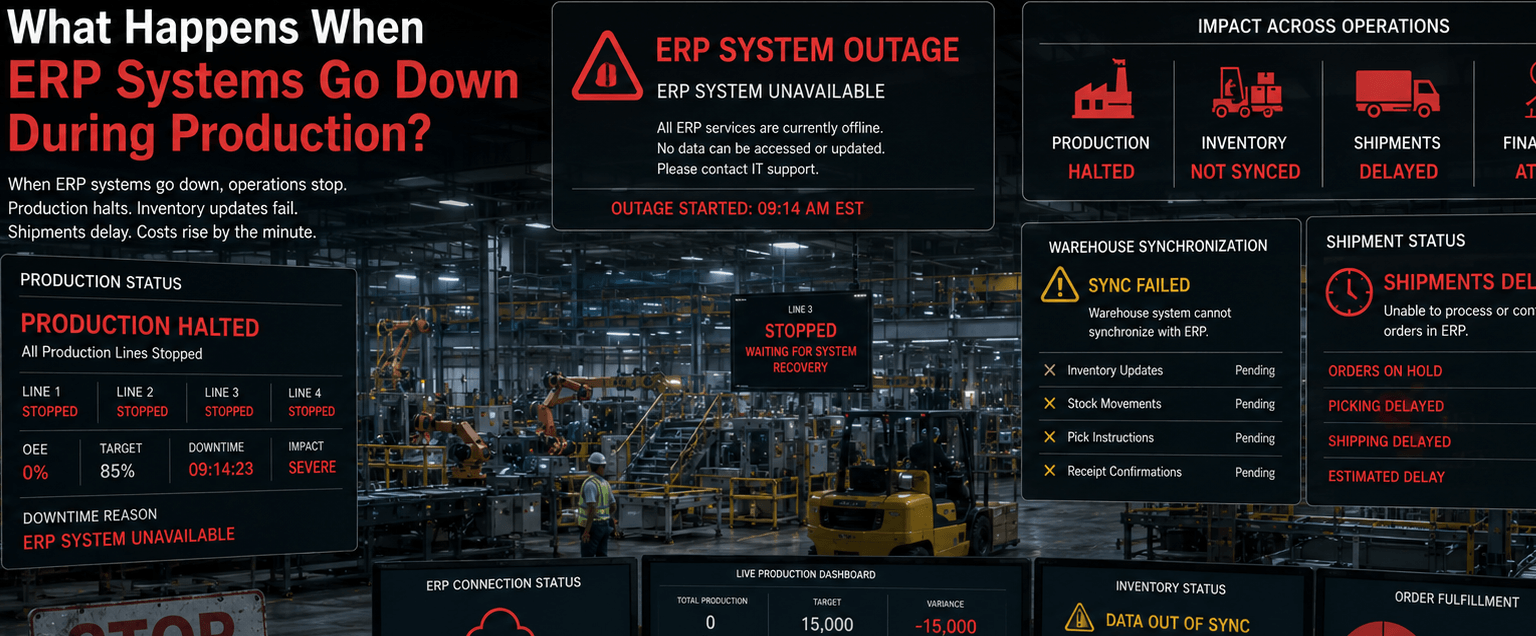
ERP outages can disrupt manufacturing operations within minutes, affecting production scheduling, inventory visibility, shipping coordination, purchasing, quality tracking, and operational decision-making across the entire facility. For manufacturers with 20–100 employees, even a short ERP outage lasting 2–6 hours can create costly operational consequences including idle labor, delayed shipments, inventory inaccuracies, overtime recovery costs, and missed production deadlines.
Many manufacturers assume ERP downtime is simply an “IT issue.” In reality, ERP systems often function as the operational backbone of modern manufacturing environments. When ERP platforms become unavailable due to ransomware, server failures, network outages, failed updates, or infrastructure instability, the operational impact quickly spreads beyond accounting and administration into production continuity itself.
The 5 Biggest Operational Problems ERP Downtime Creates
ERP outages affect far more than office productivity. In manufacturing environments, they often trigger operational disruption across production, warehousing, shipping, procurement, and customer fulfillment simultaneously.
1.Production Scheduling Becomes Disconnected
Manufacturing operations rely heavily on ERP systems for:
- production scheduling
- work order management
- material planning
- machine coordination
- labor allocation
When ERP systems fail, production schedules may freeze, operators lose visibility into priorities, manual workarounds increase confusion, and throughput slows significantly.
Even short ERP outages can disrupt production planning for the rest of the day.
2.Inventory Accuracy Starts Breaking Down
ERP downtime often interrupts:
- inventory synchronization
- barcode processing
- warehouse scanning
- raw material tracking
- finished goods updates
This creates inventory discrepancies, duplicate entries, shipping confusion, material shortages, and production bottlenecks.
Many manufacturers discover inventory issues only after ERP systems return online.
3.Shipping and Fulfillment Delays Escalate Quickly
Shipping operations often depend directly on ERP connectivity. ERP outages may disrupt:
- order processing
- shipping label generation
- warehouse coordination
- outbound logistics
- customer communication
Operational consequences may include missed delivery windows, delayed customer shipments, overtime warehouse labor, and fulfillment bottlenecks.
A short ERP outage can create operational delays that continue for days.
4.Purchasing and Supply Chain Coordination Slows Down
Manufacturers rely on ERP systems to manage:
- purchase orders
- supplier coordination
- material forecasting
- inbound inventory tracking
When ERP systems go down, purchasing visibility declines, supply chain communication slows, and procurement delays increase.
ERP outages can create downstream production disruptions long after systems recover.
5.Management Loses Operational Visibility
ERP systems provide operational insight into:
- production status
- inventory levels
- labor utilization
- shipping progress
- operational KPIs
During outages, reporting visibility disappears, decision-making slows, manual coordination increases, and operational risk rises.
Manufacturers often underestimate how dependent operations have become on ERP visibility.
The Most Common Causes of ERP Downtime
ERP outages rarely happen because of one isolated issue. Most incidents involve multiple infrastructure or operational dependencies failing together.
Common ERP Downtime Triggers
- Network Infrastructure Failures
- aging switches
- unstable firewalls
- internet outages
- Wi-Fi instability
- VPN disruptions
- Cybersecurity Incidents
- ransomware attacks
- compromised user accounts
- malware infections
- phishing-related compromise
- Server and Storage Failures
- aging hardware
- failed virtual infrastructure
- storage corruption
- insufficient redundancy
- Backup and Recovery Problems
- failed restores
- corrupted databases
- incomplete ERP backups
- slow recovery procedures
- Failed Updates or Configuration Changes
ERP environments may become unstable due to:
- untested updates
- patching failures
- integration conflicts
- vendor misconfigurations
Many ERP outages begin with small infrastructure issues manufacturers initially overlook.
Why ERP Downtime Hits Manufacturers Harder Than Other Businesses?
Manufacturing operations depend heavily on real-time operational coordination.
Key Manufacturing Vulnerabilities
1.ERP Systems Connect Multiple Operational Functions
Unlike office-only environments, manufacturing ERP systems often connect:
- production
- warehousing
- inventory
- purchasing
- shipping
- quality tracking
2.Production Delays Compound Quickly
Small disruptions may create:
- missed production windows
- overtime recovery
- shipping backlogs
- customer dissatisfaction
3.Legacy Infrastructure Increases Risk
Many manufacturers continue operating:
- aging ERP servers
- unsupported databases
- outdated network infrastructure
- unsegmented production environments
4.Limited Internal IT Resources
Manufacturers with 20–100 employees often:
- lack ERP recovery planning
- rely on reactive support
- postpone infrastructure modernization
ERP downtime often exposes operational weaknesses manufacturers didn’t realize existed.
The Real Operational Cost of ERP Downtime (Illustrative Examples)
Furniture Manufacturer
A furniture manufacturer loses ERP connectivity during active production scheduling.
Operational impact:
- CNC production sequencing delayed
- warehouse coordination disrupted
- outbound shipment schedules affected
- manual inventory tracking required
Estimated disruption:
- 6+ hours of operational inefficiency
- overtime labor recovery costs
Beverage Manufacturer
A ransomware incident affects ERP and inventory synchronization systems.
Operational impact:
- batch tracking interrupted
- shipping coordination delayed
- production scheduling frozen
- warehouse processing slowed
Estimated operational impact:
- delayed customer shipments
- operational backlog extending multiple days
Plastics Manufacturer
An aging server failure causes ERP database corruption during active production.
Operational impact:
- production scheduling unavailable
- purchasing coordination delayed
- inventory inaccuracies introduced
- operators forced into manual workflows
Root cause:
- unsupported infrastructure
- incomplete recovery planning
- lack of redundancy
ERP downtime frequently creates operational disruption far beyond the original outage window.
How Manufacturers Reduce ERP Downtime Risk
The 5-Layer ERP Continuity Framework
1.Modernize Aging Infrastructure
Manufacturers should regularly evaluate ERP servers, storage systems, firewalls
switches, and virtualization infrastructure.
Unsupported infrastructure significantly increases ERP outage risk.
2.Segment ERP and Production Environments
Separating ERP systems, office networks, production environments, and backup systems helps improve operational stability, ransomware containment, and recovery speed.
3.Validate ERP Backup and Recovery Procedures
Manufacturers should regularly test:
- ERP database recovery
- application restoration
- recovery timelines
- operational failover procedures
ERP recovery should be validated under realistic operational conditions.
4.Implement Continuous Monitoring
Proactive monitoring helps detect storage failures, abnormal network behavior, server instability, and resource bottlenecks before outages escalate.
5.Build an ERP Operational Recovery Plan
Manufacturers should define:
- ERP recovery priorities
- operational communication procedures
- production recovery sequencing
- recovery time expectations
ERP continuity planning protects operational stability, not just data.
Warning Signs Manufacturers Should Not Ignore
Manufacturers should investigate:
- Slow ERP response times
- Intermittent inventory synchronization failures
- Recurring database errors
- Warehouse barcode delays
- ERP disconnections during production
- Increasing server instability
- Failed ERP backups
- Recurring VPN or remote access interruptions
Small ERP performance issues often indicate larger operational risks developing underneath.
Illustrative Scenario: ERP Failure Disrupts Production Operations
A 75-employee beverage manufacturer in Los Angeles experienced an ERP outage caused by aging storage infrastructure and incomplete backup validation.
Initially, the issue appeared isolated to accounting functions. However, within hours the outage disrupted:
- production scheduling
- inventory synchronization
- warehouse coordination
- batch tracking
- shipping preparation
Operational consequences included:
- delayed production planning
- overtime labor recovery
- shipment coordination delays
- manual operational workarounds
The company later discovered:
- ERP recovery procedures were outdated
- infrastructure monitoring was limited
- storage redundancy was insufficient
After implementing infrastructure modernization, ERP recovery testing, proactive monitoring, segmented backup systems, and operational continuity planning, the manufacturer significantly improved ERP resilience and reduced future downtime exposure.
Why Work With an IT Provider That Understands Manufacturing ERP Environments?
Manufacturers should work with IT providers that understand:
- ERP operational dependencies
- production continuity requirements
- manufacturing recovery priorities
- ransomware protection strategies
- operational visibility systems
- warehouse and inventory workflows
An ERP outage affects far more than software availability. It affects operational continuity across the entire manufacturing environment.
Trust Signals
Fothion supports manufacturing companies that require:
- reliable ERP infrastructure
- operational continuity planning
- proactive monitoring and maintenance
- cybersecurity-first manufacturing environments
- business continuity and recovery readiness
- manufacturing-focused IT strategy
With over 20 years of experience (since 2001), Fothion helps manufacturers reduce ERP downtime risk, improve operational visibility, and strengthen production continuity.
Get an ERP Downtime Risk Assessment (30 Minutes)
If you’re unsure how exposed your ERP environment may be to operational disruption, the fastest next step is identifying your biggest ERP continuity risks.
Book a 30-minute call with Fothion and we’ll:
- review ERP infrastructure vulnerabilities
- assess operational recovery readiness
- identify downtime bottlenecks
- evaluate backup and recovery exposure
- outline practical ways to improve ERP resilience
Book here: https://www.fothion.com/schedule-a-phone-call/
FAQs (with answers):
1.What happens when ERP systems go down in manufacturing?
ERP outages can disrupt production scheduling, inventory management, shipping coordination, purchasing, warehouse operations, and operational visibility across the manufacturing environment.
2.What causes ERP downtime most often?
Common causes include ransomware attacks, aging infrastructure, server failures, network instability, failed updates, storage problems, and incomplete recovery planning.
3.Why is ERP downtime so disruptive for manufacturers?
Manufacturers rely heavily on ERP systems to coordinate production, inventory, shipping, purchasing, and operational workflows in real time.
4.How long does ERP recovery usually take?
Recovery time varies depending on infrastructure, backup readiness, and outage severity. Without proper planning, recovery may take hours or even multiple days.
5.How can manufacturers reduce ERP downtime risk?
Manufacturers can reduce ERP downtime through proactive monitoring, infrastructure modernization, backup validation, segmentation, and operational recovery planning.
6.Are ERP backups enough to protect manufacturing operations?
No. Manufacturers also need tested recovery procedures, operational continuity planning, infrastructure redundancy, and ransomware protection strategies.