
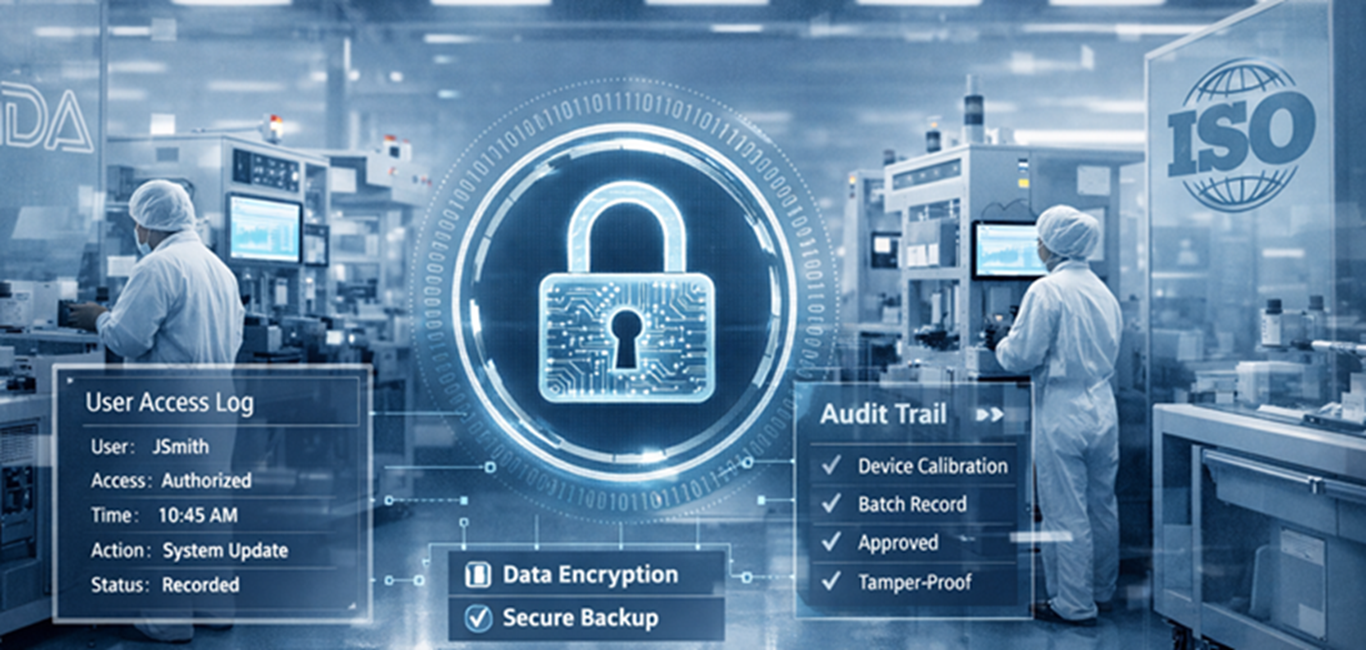
Medical device manufacturers must meet strict IT compliance requirements under FDA 21 CFR Part 11 and ISO 13485, especially when managing electronic records, quality systems, and production data. For companies with 20–100 employees, achieving compliance typically requires 4–7 core IT controls, including secure data storage, audit trails, access controls, and validated systems. Most manufacturers spend $2,000–$8,000/month on IT environments that support compliance, depending on complexity, systems (ERP, QMS), and cybersecurity requirements.
Failure to meet these standards can result in failed audits, product recalls, or regulatory penalties, making IT infrastructure a critical compliance component, not just an operational tool.
The 5 Core IT Compliance Requirements for Medical Device Manufacturers
Medical device manufacturers must implement five core IT control layers to meet FDA 21 CFR Part 11 and ISO 13485 requirements. These are not optional. They form the foundation of audit readiness and data integrity.
- Electronic Records & Audit Trail Compliance (FDA 21 CFR Part 11)
Your systems must maintain secure, time-stamped audit trails for all regulated data. This includes:
- Automatic logging of all user activity (create, edit, delete)
- Tamper-proof audit logs that cannot be altered or deleted
- Version control for documents, including engineering files and quality records
If you cannot prove who changed what and when, you will fail an audit.
- Access Control & User Authentication
Every user must have controlled, traceable access to systems handling regulated data. This requires:
- Role-Based Access Control (RBAC): Users only access what their role requires
- Multi-Factor Authentication (MFA): Required for all critical systems
- Unique user IDs: No shared logins under any circumstances
Shared accounts are one of the fastest ways to trigger compliance violations.
- System Validation & Documentation
Any system used in production or quality processes must be validated and documented. This includes:
- Validated ERP, QMS, and CRM systems (with documented testing)
- Standard Operating Procedures (SOPs) for IT processes
- Change control procedures for updates, patches, and system modifications
If a system impacts product quality or traceability, it must be validated—not just installed.
- Data Integrity & Backup Compliance
You must ensure that data is accurate, recoverable, and protected at all times. Key requirements:
- Automated daily backups with offsite or immutable storage
- Regular backup testing (monthly + quarterly restore validation)
- Defined data retention policies aligned with regulatory requirements
- Disaster recovery plans with clear RTO (Recovery Time Objective) and RPO (Recovery Point Objective)
Backups that are never tested are considered non-compliant.
- Cybersecurity Controls for Regulated Data
Cybersecurity is now a core compliance requirement, not just best practice. Minimum controls include:
- Endpoint Detection & Response (EDR) for threat monitoring
- Network monitoring and intrusion detection
- Ransomware protection and isolation strategies
- Email security and phishing defense
A ransomware incident that compromises regulated data can trigger both security and compliance violations.
How FDA 21 CFR Part 11 and ISO 13485 Impact Your IT Systems
FDA and ISO standards don’t apply to just one system. They apply to your entire IT environment.
Here’s how they impact key systems:
- ERP Systems (Production + Traceability):
Must track batch records, production data, and changes with full audit trails.
- QMS Platforms (Quality Documentation):
Require strict version control, approval workflows, and traceability for audits.
- Document Control Systems:
Must ensure that only the latest approved versions are accessible and all changes are logged.
- Cloud vs. On-Premise Infrastructure:
Both must meet the same compliance standards. Cloud does not remove responsibility for validation, access control, or auditability.
- Email & Communication Systems:
Often overlooked, but critical. Communications tied to quality decisions or approvals may be audited.
Key Insight: Compliance is system-wide, not just your QMS.
If your ERP, backups, or email systems fail compliance checks, your entire operation is at risk.
IT Systems That Must Be Compliance-Ready (Most Companies Miss This)
Many manufacturers focus only on QMS but audits often extend into every system that touches regulated data.
Compliance-Ready Systems Checklist
ERP Systems
- Batch tracking and traceability enabled
- Audit logs active and retained
- Role-based access enforced
QMS Platforms
- CAPA and non-conformance tracking documented
- Approval workflows enforced
- Version control enabled
File Servers (Engineering / CAD Data)
- Access restrictions in place
- File versioning enabled
- Audit logs for file access
Backup Systems
- Immutable or ransomware-protected backups
- Daily backups + offsite replication
- Monthly and quarterly restore testing
Cloud Applications (Microsoft 365 / Google Workspace)
- MFA enforced across all users
- Audit logging enabled
- Data retention policies configured
IoT / Production Systems (if connected)
- Network segmentation in place
- Access control for operators and engineers
- Monitoring for anomalies
Critical Insight:
Many manufacturers assume compliance only applies to QMS but auditors often review ERP systems, backups, file servers, and even email platforms. Missing controls in any of these areas can result in audit findings.
Common Compliance Failures That Lead to Audit Issues
The Most Common Failures
- No audit trails or incomplete logs
- Shared user accounts across teams
- Unvalidated ERP, QMS, or document systems
- Backups running but never tested
- No documented IT procedures or SOPs
- Weak or outdated cybersecurity controls
What Happens When These Fail
- Failed FDA audits → Delays in product approvals or inspections
- ISO certification delays → Lost contracts or inability to bid on regulated work
- Production downtime risks → Systems fail with no recovery plan
- Cyber insurance claim denials → If required controls are missing
- Reputation damage → Loss of trust with partners and regulators
In many cases, companies don’t realize these gaps exist until an audit or incident exposes them.
Step-by-Step: How to Become IT-Compliant (For 20–100 Employee Manufacturers)
For most manufacturers, achieving compliance takes 60–120 days, depending on system complexity and current gaps.
Step 1: Compliance Gap Assessment
Review your current environment against FDA and ISO requirements
Identify missing controls, risks, and documentation gaps
Step 2: Identify Regulated Systems
Map all systems that impact product quality or traceability:
- ERP
- QMS
- File storage
- Backup system
Step 3: Implement Required Controls
Deploy and configure:
- Audit logging
- MFA and access controls
- Backup and recovery systems
- Cybersecurity protections
Step 4: Validate Systems & Document Everything
- Perform system validation (testing + documentation)
- Create SOPs for IT processes
- Implement change control procedures
Step 5: Ongoing Monitoring & Quarterly Reviews
- Continuous monitoring of systems
- Quarterly compliance reviews
- Regular backup and recovery testing
Compliance is not a one-time project. It’s an ongoing operational discipline.
Illustrative Scenario: Medical Device Manufacturer Compliance Recovery
A 45-employee medical device manufacturer in Los Angeles failed an ISO audit due to missing audit trails and untested backups. Their ERP system had limited logging, and shared user accounts made activity tracking impossible.
After implementing a structured compliance program:
- Role-based access and MFA were enforced across all systems
- Audit logging was enabled for ERP, file servers, and cloud platforms
- Automated backups were paired with monthly and quarterly restore testing
- System validation and documentation were completed
Result:
The company passed its next audit within 90 days and reduced downtime risk by an estimated 40%, while improving traceability across production and quality systems.
Why Work With an IT Provider That Understands FDA & ISO Compliance
Medical device manufacturers should work with IT providers who understand:
- Regulatory frameworks like FDA 21 CFR Part 11 and ISO 13485
- ERP and QMS system requirements for traceability and validation
- Cybersecurity risks in regulated manufacturing environments
- How to align IT infrastructure with audit and compliance expectations
A specialized provider doesn’t just “manage IT”. They help ensure your systems are audit-ready, secure, and aligned with production requirements.
Trust Signals
Fothion supports manufacturing companies that require:
- Secure ERP and production system environments
- Reliable backup and disaster recovery strategies
- Cybersecurity controls aligned with compliance requirements
- Long-term IT planning tied to operational stability
With over 20 years of experience (since 2001) supporting complex IT environments, Fothion helps manufacturers reduce risk, improve uptime, and prepare for regulatory audits.
Get Your Manufacturing IT Compliance Snapshot (30 Minutes)
If you’re unsure whether your systems would pass an FDA or ISO audit, the fastest next step is to identify your biggest compliance gaps.
Book a 30-minute call with Fothion and we’ll:
- assess your current environment against core compliance requirements
- identify the top 3 risks (audit failure, downtime, data exposure)
- outline quick wins to improve compliance without disrupting production
Book here: https://www.fothion.com/schedule-a-phone-call/
FAQs (with answers):
1. What is FDA 21 CFR Part 11 in simple terms?
FDA 21 CFR Part 11 is a regulation that requires electronic records and signatures to be secure, traceable, and tamper-proof. For manufacturers, this means systems like ERP and QMS must have audit trails, user access controls, and validated processes to ensure data integrity.
2. What IT systems must be compliant in a medical device company?
Compliance applies to all systems that handle regulated data, including ERP systems, QMS platforms, document control systems, file servers, and even email systems if they are used for approvals or quality-related communication.
3. How long does it take to become IT compliant for FDA and ISO?
Most manufacturing companies can achieve baseline IT compliance within 60–120 days, depending on system complexity, existing gaps, and documentation readiness. Highly regulated environments may require longer validation and testing phases.
4. What are the most common IT compliance failures?
The most common issues include missing audit trails, shared user accounts, unvalidated systems, untested backups, and lack of documented IT procedures. These gaps often lead to failed audits or delays in certification.
5. Do cloud systems automatically meet FDA or ISO compliance?
No—cloud systems are not automatically compliant. While cloud providers handle infrastructure security, manufacturers are still responsible for configuring access controls, audit logs, validation, and data integrity to meet regulatory requirements.
6. How much does IT compliance cost for a medical device manufacturer?
Most companies spend between $2,000–$8,000 per month on IT environments that support compliance, depending on system complexity, security requirements, and the level of validation needed.