
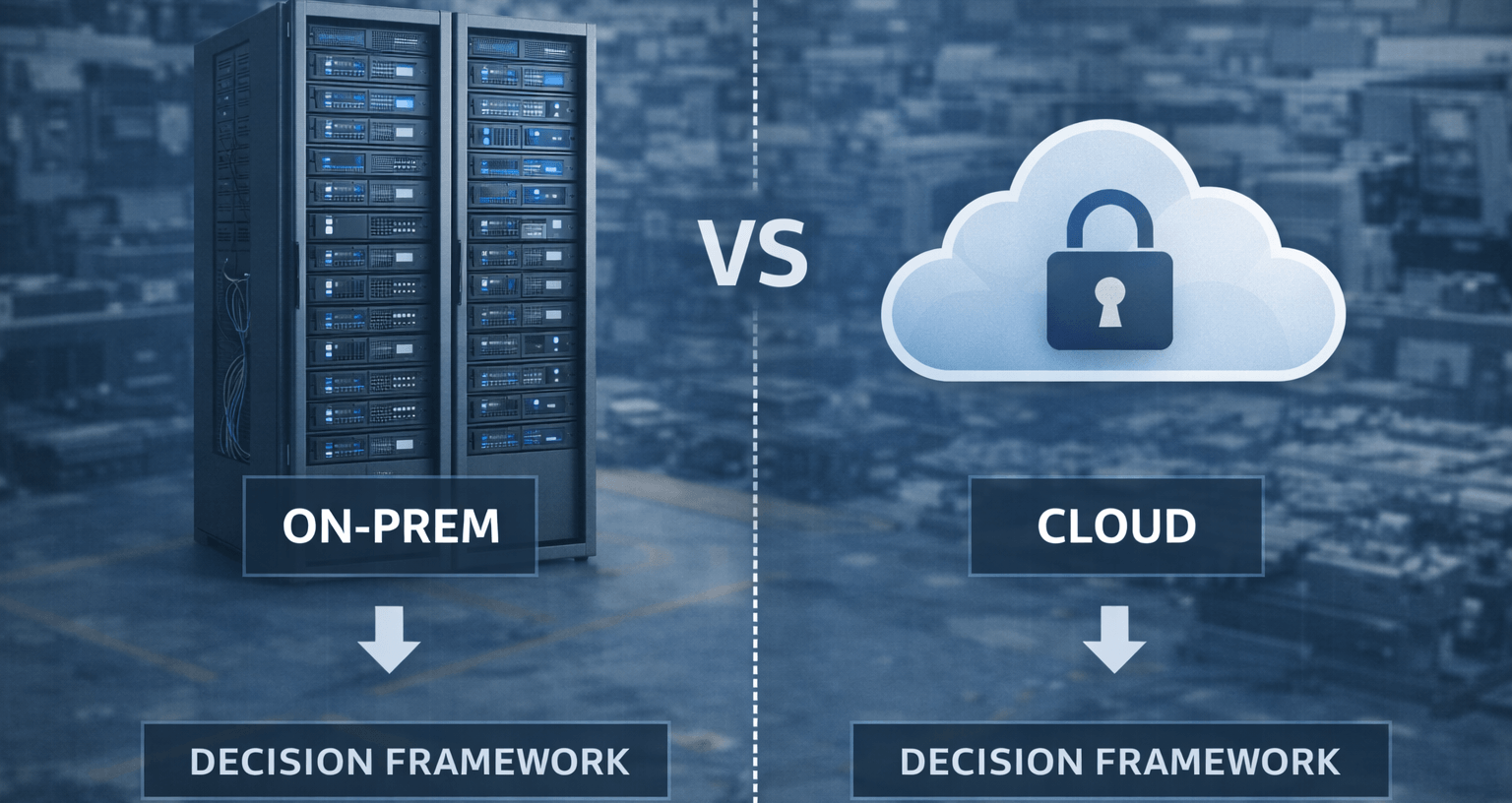
For many 20–100 employee manufacturers, the best ERP hosting decision depends on uptime needs, connectivity reliability, compliance expectations, and security maturity. On-prem offers control but increases hardware and recovery responsibility. Cloud-hosted ERP can improve resilience, but only if identity security and monitoring are strong. Many manufacturers plan this decision over 6–18 months, especially with integrations and data cleanup.
The On-Prem vs Cloud ERP Decision Framework (6 Factors)
- Uptime Requirements (What Happens if ERP Is Down?)
- If ERP downtime stops shipping/production, prioritize resilience.
- Define targets: ERP RTO 4–12 hours and RPO 1–4 hours (adjust for your business).
- Connectivity Reality (Can You Operate If Internet Is Down?)
- If internet outages are common, on-prem may feel safer—but only if you have redundancy.
- If cloud is chosen, plan:
- Secondary internet
- Failover plans
- Offline procedures for critical operations
- Security Model (Identity Is Everything)
Cloud doesn’t automatically mean safer. Your security hinges on:
- MFA enforcement
- Conditional access
- Admin separation
- Monitoring and logging
- Vendor access control
- Cost Predictability
On-prem often includes:
- Server refresh cycles every 4–6 years
- Storage growth surprises
- Backup complexity
Cloud often includes:
- Predictable monthly fees
- Potential migration costs
- Ongoing security configuration responsibility
- Compliance / Customer Requirements
Some customers want proof of controls and recovery readiness more than “where it is hosted.”
Either model requires documentation and evidence (especially aerospace customers).
- Recovery & Testing
The question isn’t “cloud or on-prem.”
It’s: how fast can we restore ERP and prove it?
Minimum standard:
- Monthly restore spot checks
- Quarterly ERP restore validation
- Annual DR simulation
The Best Hybrid Option for Many Manufacturers
Many manufacturers choose:
- Cloud identity + security controls
- ERP hosted in a hardened environment (cloud or managed hosting)
- Local redundancy for production-critical processes
- Tested backups and documented recovery
Illustrative Scenario: Choosing On-Prem vs Cloud Based on Recovery Targets
A 65-employee machining company was debating ERP on-prem vs cloud while running on aging hardware. They hadn’t defined recovery targets, and no one could confidently state how quickly ERP could be restored.
After a structured program:
- ERP RTO/RPO targets were defined based on production and transaction needs
- Backups were validated with restore testing to confirm real recovery timelines
- Identity security was hardened (MFA, admin separation, least privilege)
- A phased modernization plan was built to improve resilience first, then hosting
Result: the hosting decision became clear—and modernization happened without disrupting production.
Trust Signals
- ERP modernization planning experience
- Risk-first identity/security controls
- Restore testing and DR documentation
- Production-friendly migration planning
Make the ERP Hosting Decision with a Clear Risk Framework
On-prem vs cloud isn’t a debate. It’s a risk and recoverability decision. The right choice is the one you can secure, support, and restore on your timeline.
Book a 30-minute call with Fothion today and we’ll:
- compare real costs (refresh cycles vs monthly fees) for your ERP setup
- define ERP recovery targets and connectivity requirements
- outline a phased plan that improves resilience first, then modernizes hosting without disruption